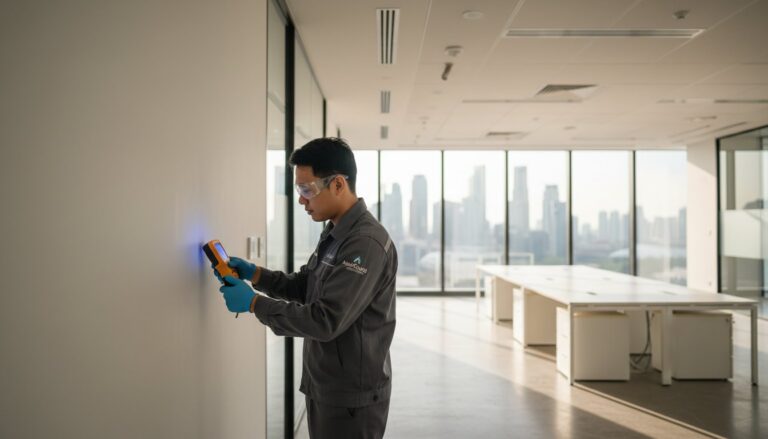


Closing an office or upgrading your workspace in Singapore often comes with a hidden headache: what do you do with all the surplus furniture and equipment? For many businesses, it’s a costly and complex problem, involving high disposal fees, logistical challenges, and the pressure to meet ESG targets. The thought of sending perfectly good assets to the landfill is not just environmentally irresponsible—it’s a missed financial opportunity.
But what if you could transform this operational challenge into a strategic advantage? This is the core principle behind asset value recovery, a comprehensive process designed to turn your unwanted office assets into a tangible financial return. It’s the smart, sustainable alternative to traditional disposal, aligning your budget with your environmental commitments.
In this guide, we demystify the process for Singapore businesses. You will learn how to simplify your office exit, generate unexpected revenue from surplus items, and achieve a documented, sustainable clearance. It’s time to stop viewing old assets as a liability and start unlocking their hidden value.
Defining Asset Value Recovery in the Modern Office Context
When an office undergoes a relocation, renovation, or closure, the conversation often turns to disposal costs. However, a forward-thinking strategy can transform this liability into a significant financial and environmental win. This is the core of asset value recovery—a strategic process that goes far beyond simply selling used items. It’s about systematically identifying, evaluating, and extracting the maximum possible value from surplus office assets, from furniture and IT equipment to fixtures and fittings.
Instead of paying hefty fees for removal and disposal, this approach creates a new revenue stream while championing corporate responsibility. It’s a pivotal shift from the linear “take-make-dispose” model to a circular one, where the lifecycle of every asset is extended, contributing directly to a more sustainable economy.
What is Asset Value Recovery?
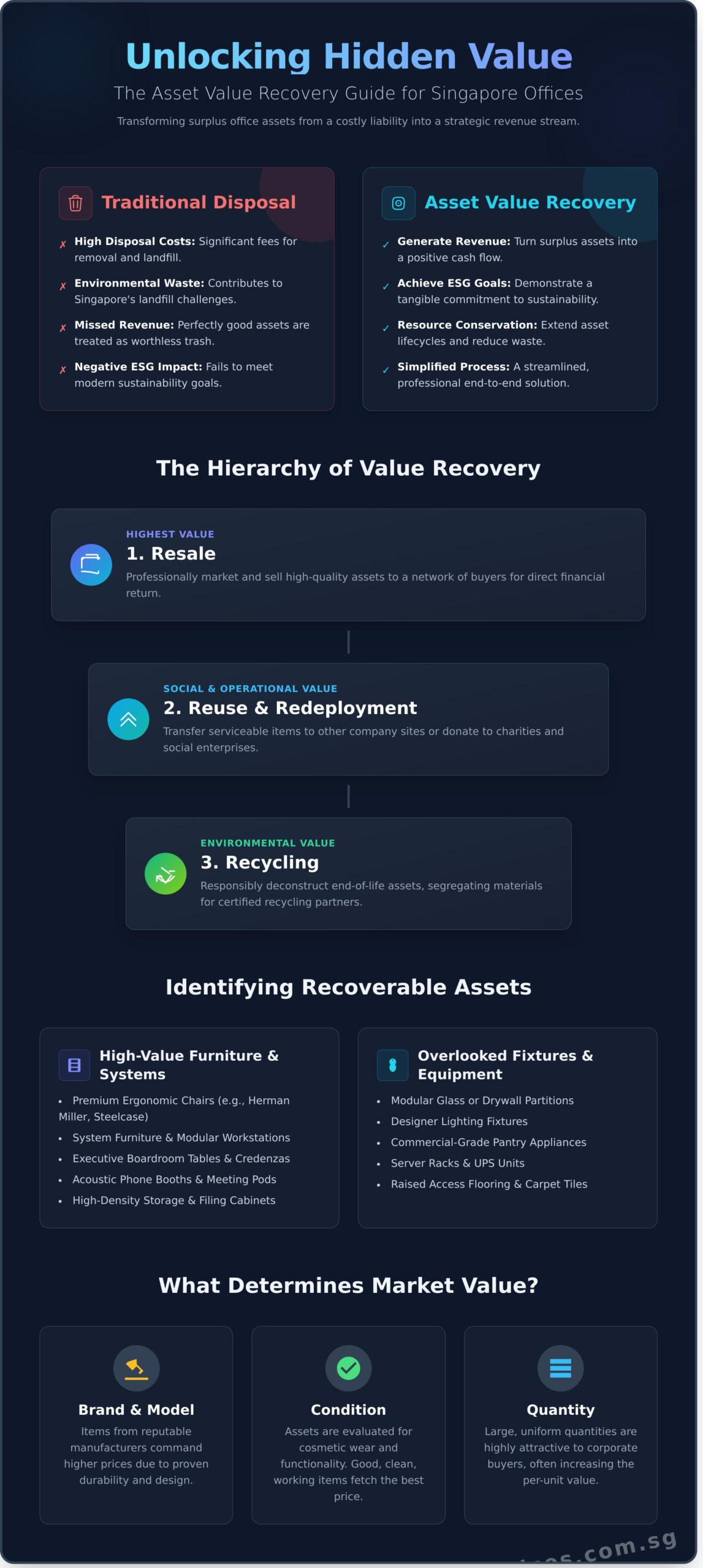
At its heart, asset value recovery is a comprehensive process for managing surplus or end-of-life assets to prevent them from becoming waste. The general practice of asset recovery involves maximizing the value of these items through a clear hierarchy of solutions. This includes professional resale, refurbishment to extend usability, internal redeployment to other company sites, and finally, responsible recycling for materials that have no further functional use. It turns the complex logistics of an office clear-out into a streamlined, value-generating operation.
Why It Matters for Singapore Businesses
In a resource-constrained landscape like Singapore, the case for asset value recovery is particularly compelling. With high commercial disposal costs and the Semakau Landfill rapidly approaching capacity, businesses face mounting financial and regulatory pressure to reduce waste. Adopting this strategy directly addresses these challenges by diverting tons of material from landfill. Furthermore, it strongly aligns with the growing emphasis on Environmental, Social, and Governance (ESG) goals, allowing companies to demonstrate a tangible commitment to sustainability while freeing up capital that would otherwise be lost to disposal fees.
The Core Principles: Resale, Reuse, and Recycling
A successful asset value recovery program is built on three core principles that prioritize value and sustainability:
- Resale: High-quality assets like ergonomic chairs, workstations, and operational IT equipment are professionally assessed, marketed, and sold to a network of buyers, generating a direct financial return.
- Reuse/Redeployment: Serviceable items that may not have high resale value can be redeployed to other office locations, donated to charities, or provided to social enterprises, fulfilling corporate social responsibility objectives.
- Recycling: For assets that have reached the true end of their life, the final step is responsible deconstruction. Materials like metal, wood, and plastic are segregated and sent to certified recycling partners, ensuring minimal environmental impact.
Identifying Recoverable Value: What Are Your Office Assets Worth?
To optimize your budget during an office transition, the first step is to stop seeing your space as just four walls and a floor plan. Instead, view it as a portfolio of valuable assets. Many items you might consider disposable actually hold significant resale value in the secondary market. A comprehensive asset value recovery strategy begins with a detailed inventory, transforming what could be a disposal cost into a tangible financial return. This mindset is not just financially prudent; it aligns with broader principles of responsible resource management, echoing the diligence seen in international standards for asset recovery.
High-Value Assets: Office Furniture and Systems
The most significant value is often found in your core office furniture. Premium ergonomic chairs from brands like Herman Miller and Steelcase are consistently in high demand. Beyond individual seating, complete system furniture—including workstations, modular desking, and collaborative pods—retains substantial value. Don’t forget large-ticket items like executive boardroom tables, acoustic phone booths, and high-density storage cabinets, which are prime candidates for recovery.
Often Overlooked Assets: Fixtures and Equipment
Hidden value often lies in items that are physically part of the office structure but can be professionally removed and repurposed. This includes modular glass or drywall partition walls, designer lighting fixtures, and commercial-grade pantry appliances. Even specialised infrastructure like server room racks, uninterrupted power supply (UPS) units, raised access flooring, and high-quality carpet tiles can be recovered and sold, contributing positively to your project’s bottom line.
Assessing Condition: What Determines Market Value?
The recoverable value of any asset is determined by a few key factors. A professional assessment will consider these elements to establish a fair market price:
- Brand and Model: Items from reputable, well-known manufacturers command higher prices due to their proven durability and design appeal.
- Condition: Assets are evaluated for cosmetic wear, mechanical functionality, and structural integrity. Items in good, clean, and fully working order will always fetch the best price.
- Quantity: A large, uniform quantity of a single item (e.g., 100 identical workstations) is highly attractive to corporate buyers looking to furnish a new space, often increasing the per-unit value.
The Asset Value Recovery Process: A Step-by-Step Framework
A successful asset value recovery initiative transforms a complex logistical challenge into a streamlined, value-generating process. For busy facility managers, navigating this alone can be overwhelming. Partnering with a specialist demystifies the journey, ensuring every step is handled with professional precision for maximum efficiency, safety, and financial return. Our proven four-step framework breaks it down.
Step 1: Consultation and Asset Inventory
The process begins with a thorough on-site consultation to understand your project goals, timelines, and specific site requirements. Our team then conducts a meticulous inventory, systematically cataloguing every item—from designer furniture and ergonomic chairs to servers, AV equipment, and specialized fixtures. Each asset is photographed and its condition is graded, creating a clear baseline to differentiate items with high resale potential from those destined for recycling or disposal.
Step 2: Valuation and Proposal
Leveraging deep knowledge of the Singaporean second-hand market, we research and assign a fair, data-driven market value to each recoverable asset. We then present a completely transparent proposal outlining your options. This may include a direct buyback offer for an immediate cash injection (in SGD) or flexible consignment terms to maximize returns over time. The proposal also clearly itemises any projected costs for labour, transport, and certified disposal, ensuring full clarity from the start.
Step 3: Logistics and Decommissioning
Execution is where expertise matters most. Once the proposal is approved, our logistics team coordinates a systematic decommissioning plan that aligns perfectly with your schedule, especially during critical lease-end handovers. Our trained technicians professionally and safely dismantle all furniture, partitions, and equipment, adhering to strict workplace safety protocols to protect your premises and our team. We manage the entire removal and transportation, guaranteeing a smooth, non-disruptive exit.
Step 4: Remarketing and Final Reporting
We activate our extensive network of corporate buyers, resellers, and upcycling partners to remarket your assets effectively. Our goal is to find the right buyer to secure the best possible return. Upon completion, you receive a comprehensive final report that provides a full breakdown of the entire project. This document details what was sold, recycled, and disposed of, offering auditable data for your financial records and powerful metrics for your ESG reporting on landfill diversion and circular economy contributions. Let us manage the process for you. Get a no-obligation assessment.
Choosing Your Asset Recovery Partner in Singapore
Selecting a partner for your office exit in Singapore is a critical decision that goes far beyond selling used furniture. A strategic partner manages the entire decommissioning process, transforming a complex logistical challenge into a financial and operational success. They should function as an extension of your team, focused on maximizing value while minimizing your administrative burden.
When you choose a provider, you are entrusting them with the final, crucial stage of your tenancy. The right choice ensures a smooth, cost-effective, and compliant handover, while the wrong one can lead to unforeseen costs and landlord disputes.
Key Capabilities to Look For
To ensure a successful project, evaluate potential partners on their ability to deliver a holistic solution. Look for these essential capabilities:
- Proven Track Record: A strong history and an extensive network of buyers in the secondary market are non-negotiable. This ensures you receive fair market value for everything from workstations and IT hardware to specialised equipment.
- In-house Logistics and Manpower: A partner with their own teams, vehicles, and equipment can execute the removal and clearance process efficiently and safely. This avoids reliance on third-party contractors, reducing the risk of delays and ensuring accountability.
- Expertise in Office Reinstatement: The ideal partner understands the full scope of a lease exit, including the stringent reinstatement requirements of Singapore landlords. This integrated knowledge is key to providing a complete and seamless exit solution.
The CPL Advantage: An Integrated Solution
At CPL, we built our services around the core challenge businesses face: managing a complex office exit with multiple vendors and moving parts. Our model uniquely combines professional asset value recovery with our core office reinstatement services, all managed under one roof.
This integrated approach means you have a single, expert point of contact from start to finish. Our team handles the asset valuation, dismantling, removal, and the complete reinstatement of your premises. The process is streamlined, communication is clear, and project timelines are strictly managed.
Most importantly, this model delivers tangible financial benefits. The value we recover from your surplus assets is directly credited against your final reinstatement invoice, significantly reducing your out-of-pocket expenses in SGD. We turn a standard operational cost into a smart financial opportunity.
Discover how our integrated approach simplifies your office exit.
Unlock the Hidden Value in Your Office Assets
In today’s competitive landscape, office decommissioning is no longer just an expense—it’s an opportunity. A well-executed asset value recovery strategy does more than clear out space; it unlocks financial returns from surplus items and reinforces your company’s commitment to sustainability. This proactive approach transforms a logistical challenge into a strategic advantage, aligning your operational needs with your ESG objectives.
Choosing the right partner is critical to this process. As Singapore’s trusted partner for office reinstatement and decommissioning, CPL Services utilises a proven process to maximize financial returns on your surplus assets. Our deep commitment to circular economy principles ensures your transition is not only profitable but also environmentally responsible, helping you achieve your ESG goals.
Don’t let value go to waste. Turn your surplus assets into sustainable value. Contact CPL for a consultation.
Frequently Asked Questions About Asset Value Recovery
How is the value of my used office furniture actually determined?
The value of your assets is determined through a comprehensive assessment. Our specialists evaluate several key factors: the brand and model (e.g., Herman Miller chairs hold more value than generic ones), age, and overall condition. We also analyse current demand within Singapore’s secondary market for specific items. This detailed evaluation ensures we can offer a fair market value in SGD, maximizing the financial return on your surplus office furniture and equipment.
What happens to office assets that cannot be resold?
Our commitment is to a zero-landfill policy. Assets without resale value are channelled into our sustainable disposal streams. We prioritise donating usable items to local Singaporean charities and social enterprises. Components that cannot be donated are responsibly dismantled, with materials like metal, plastic, and wood segregated for recycling. This approach minimizes your environmental footprint and aligns with modern ESG (Environmental, Social, and Governance) goals, transforming waste into a positive outcome.
Is asset value recovery only worthwhile for large multinational corporations?
Absolutely not. While MNCs benefit greatly, asset value recovery is a financially prudent strategy for businesses of all sizes, including Singapore’s vibrant SME community. Any company vacating an office space with surplus furniture and equipment can turn a potential disposal cost into a revenue stream. Our scalable solutions ensure that whether you have a single floor or an entire building, you can unlock the residual value in your assets and reduce overall project expenses.
How does this service differ from a standard junk removal or disposal company?
A standard disposal company views your items as waste, presenting you with a bill for removal. We see them as assets with potential value. Our service transforms a disposal liability into a financial opportunity. Instead of simply hauling items to a landfill, we meticulously sort, evaluate, and find new homes for them through resale or donation. This strategic approach not only generates a return for you but also champions sustainability, unlike the linear “take-make-waste” model of junk removal.
Can the value recovered from my assets be used to pay for the reinstatement work?
Yes, this is one of the key benefits of our integrated service model. The funds generated from the sale of your surplus assets can be directly credited against the total cost of your office reinstatement project. This seamless financial arrangement simplifies your budgeting and can significantly reduce your out-of-pocket expenses. It’s a smart way to make your assets work for you one last time, turning a mandatory lease-end obligation into a more cost-effective exercise.
How much lead time is needed to plan an asset recovery project?
To maximize value, we recommend engaging with us as early as possible, ideally 4 to 6 weeks before your lease expires. This provides ample time for a thorough inventory assessment, marketing the assets to our network, and coordinating logistics without rush. While we can accommodate tighter timelines common in Singapore’s dynamic business environment, more lead time allows for a more strategic and profitable asset value recovery process, ensuring the best possible financial and sustainable outcomes.