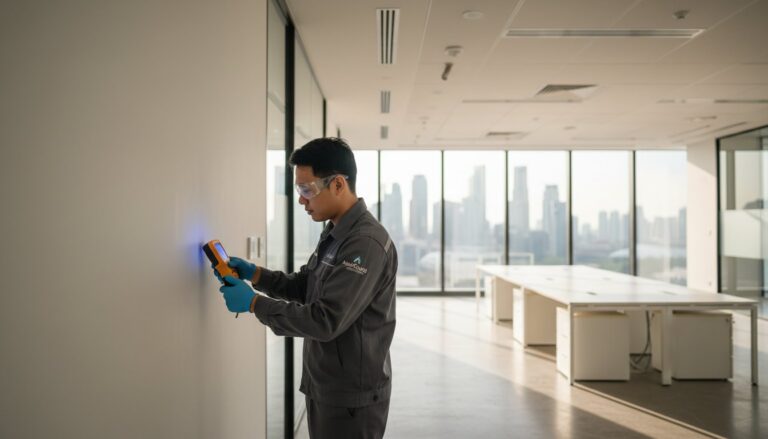


The end of your office lease is approaching, and with it comes the often-dreaded task of reinstatement. Juggling moving logistics while deciphering complex lease agreements can feel overwhelming. For many tenants, navigating the requirements for reinstatement work in Singapore is a stressful process, filled with concerns about escalating costs, tight deadlines, and the fate of a substantial security deposit.
But a smooth handover is not just possible—it’s achievable with the right strategy. This comprehensive guide is designed to transform that uncertainty into a clear, actionable plan. We will walk you through every critical step, from accurately interpreting your lease obligations and creating a realistic budget to selecting a reliable contractor and ensuring a flawless handover. Consider this your strategic roadmap to a seamless, cost-effective exit that protects your deposit and leaves nothing to chance.
Understanding Reinstatement Work: Your Commercial Lease Obligations
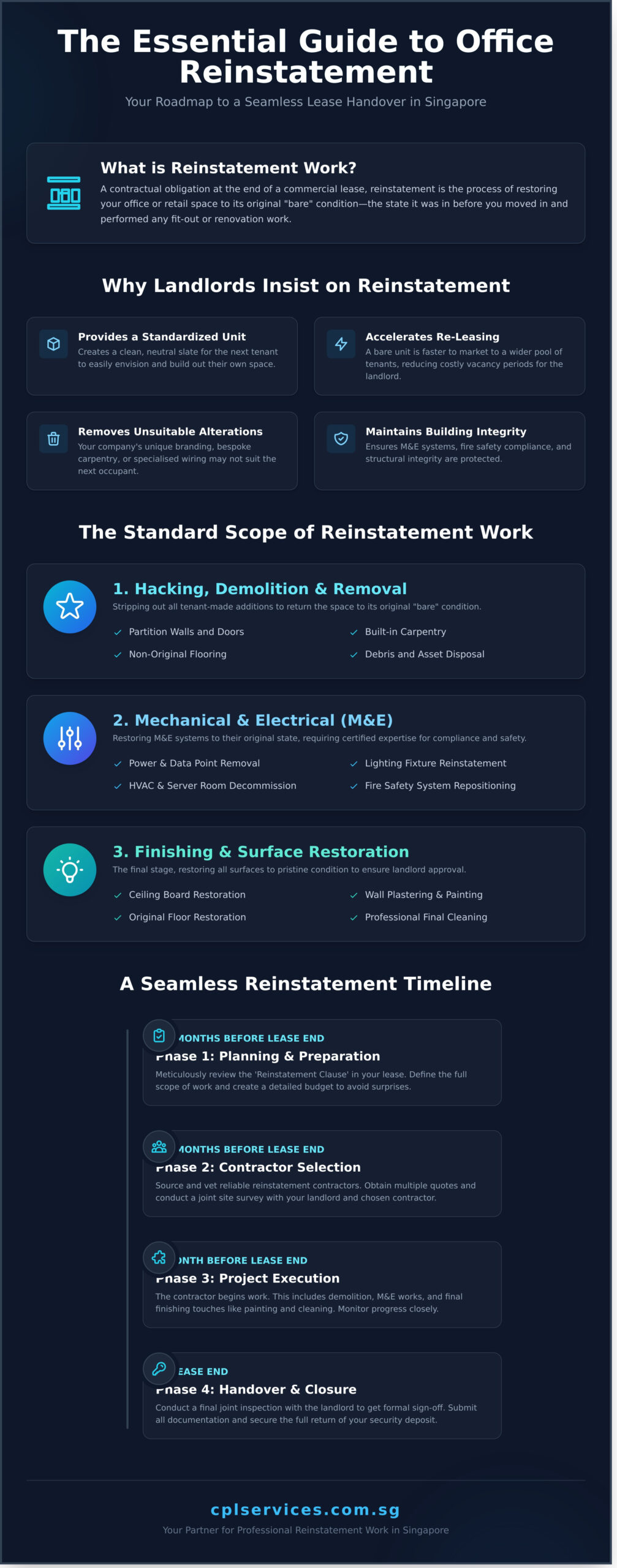
As your commercial lease in Singapore approaches its end, your responsibilities extend beyond simply vacating the premises. A crucial final step is completing the required reinstatement work. In essence, reinstatement work singapore is the process of restoring your office or retail space to its original “bare” condition—the state it was in before you moved in and began any fit-out or renovation work.
This is not an optional task but a firm contractual obligation outlined in your tenancy agreement. Failing to perform this work to the landlord’s satisfaction can lead to significant financial consequences, including the forfeiture of your security deposit and potential legal action to recover the costs the landlord incurs to complete the job on your behalf. Proper planning for reinstatement work in Singapore is essential for a smooth and cost-effective exit from your commercial property.
Decoding the ‘Reinstatement Clause’ in Your Tenancy Agreement
Typically found under the “Tenant’s Covenants” section, the reinstatement clause is the legal blueprint for your exit obligations. It specifies exactly what must be removed, repaired, or restored. This often includes dismantling partitions, removing temporary fixtures, hacking away non-original flooring, and reinstating ceiling boards and standard lighting. It is vital to review this clause meticulously before signing the lease to understand the future costs and again several months before your lease expires to plan the scope of reinstatement work singapore requires. If any terms are ambiguous, seek written clarification from your landlord to prevent disputes later.
Why Landlords Insist on Reinstatement
From a landlord’s perspective, reinstatement is a critical business practice that protects their asset and streamlines operations. It serves several key functions:
- Provides a Standardized Unit: It creates a clean, neutral slate, allowing the next tenant to envision and build out their own space without being influenced or hindered by previous customisations.
- Accelerates Re-Leasing: A bare unit is faster and easier to market to a wider pool of prospective tenants, reducing costly vacancy periods for the landlord.
- Removes Unsuitable Alterations: Your company’s unique branding, bespoke carpentry, or specialised wiring may not be suitable or desirable for the next occupant.
- Maintains Building Integrity: Reinstatement ensures that all modifications are removed correctly, protecting the building’s core M&E systems, fire safety compliance, and structural integrity.
The Standard Scope of Reinstatement Work: A Detailed Checklist
Navigating your end-of-lease obligations begins with a clear understanding of the tasks involved. While your tenancy agreement is the ultimate guide, most commercial reinstatement projects follow a standard framework. A professional contractor will always conduct a site survey to create a tailored plan, but this checklist provides a comprehensive overview of what to expect for typical reinstatement work Singapore.
Use this guide to anticipate the key phases and ensure no detail is overlooked for a smooth handover to your landlord.
Hacking, Demolition, and Removal Works
This initial phase involves stripping out all tenant-made additions to return the space to its original “bare” condition. The focus is on meticulous and safe removal.
- Partition Walls and Doors: Systematic dismantling of all temporary structures, including drywall, glass partitions, and added doorways.
- Built-in Carpentry: Careful removal of custom-built items like reception counters, feature walls, storage cabinets, and pantries.
- Flooring: Hacking and removal of non-original finishes such as vinyl, carpeting, or raised platform flooring to expose the original subfloor.
- Debris and Asset Disposal: Professional and responsible disposal of all demolition debris, unwanted furniture, and fixtures.
Mechanical & Electrical (M&E) Reinstatement
Restoring the M&E systems to their original state is a critical and technical part of the process, requiring certified expertise to ensure compliance and safety.
- Power and Data Points: Terminating and removing all additional electrical sockets, data points, and associated trunking or cabling.
- Lighting Fixtures: Reinstating the landlord’s original lighting layout, which often means removing custom fixtures and reinstalling standard ones.
- HVAC and Server Rooms: Decommissioning and removing supplementary air-conditioning units and all server room equipment, including racks and cabling.
- Fire Safety Systems: Repositioning fire sprinklers, smoke detectors, and exit signs back to their original, approved locations.
Finishing and Surface Restoration
The final stage focuses on restoring all surfaces to pristine condition, leaving the unit ready for the next tenant. Attention to detail is paramount for landlord approval.
- Ceiling Restoration: Replacing any damaged ceiling boards and ensuring the ceiling grid system matches the landlord’s original specifications.
- Wall Finishing: Patching all holes and imperfections on walls, followed by applying a fresh coat of paint using the landlord’s specified colour code.
- Floor Restoration: Depending on the original flooring, this may involve concrete grinding, polishing existing marble or tile, or replacing the entire floor finish.
- Professional Cleaning: A final, thorough cleaning of the entire unit, including windows and fixtures, to ensure it is spotless for handover.
Your Step-by-Step Guide to a Seamless Reinstatement Process
Executing successful reinstatement work in Singapore requires foresight and meticulous planning. By breaking down the process into manageable phases, you can transform this complex obligation into a streamlined project, ensuring a smooth exit from your premises and the full return of your security deposit. This guide provides a clear, chronological project plan for facility and office managers.
Phase 1: Planning & Preparation (3-6 Months Before Lease End)
This initial phase is crucial for setting the foundation for a successful project. Proactive planning prevents last-minute complications and costly oversights. Your primary goal is to understand the full scope of your obligations and identify potential partners.
- Review Your Tenancy Agreement: Scrutinize the reinstatement clause to understand the exact requirements. Note any specific conditions for hacking, demolition, or M&E works.
- Request Landlord’s Checklist: Obtain the official handover checklist from your landlord or building management. This document is your definitive guide to their expectations.
- Source Qualified Contractors: Begin researching and requesting quotations from reputable reinstatement contractors. This gives you ample time to assess their capabilities and pricing.
- Create an Asset Inventory: Catalogue all furniture, IT equipment, and fittings. Decide what will be relocated, sold, recycled, or disposed of, aligning with your company’s sustainability goals.
Phase 2: Contractor Selection & Project Kick-off (2-3 Months Before)
With your requirements clearly defined, the next step is to select the right partner to execute the work. This phase is about due diligence and locking in a detailed project plan to ensure alignment on scope, budget, and timeline.
- Compare Quotations: Evaluate bids not just on price, but on the comprehensiveness of the scope, the proposed timeline, and the contractor’s track record. Look for transparent, itemised costs.
- Verify Credentials: Ensure your chosen contractor holds relevant certifications, such as bizSAFE for safety standards and BCA (Building and Construction Authority) registration for licensed work.
- Finalize the Project Schedule: Work with your contractor to establish a detailed schedule with key milestones, from commencement to the final handover date.
Ready to find a reliable partner for your project? Get a transparent, no-obligation quote from our experts.
Phase 3: Execution & Handover (Final Month)
The final month is all about execution and coordination. Diligent project management is key to ensuring all reinstatement work is completed to the required standard, on time, and ready for the landlord’s final inspection. Effective management of your reinstatement work in Singapore is critical during this final push.
- Coordinate Schedules: Align the reinstatement timeline with your office move-out schedule to minimize disruption and ensure the site is clear for contractors.
- Conduct Regular Site Checks: Visit the site frequently to monitor progress, address any issues promptly, and ensure the quality of work meets the agreed-upon standards.
- Arrange a Joint Inspection: Schedule a pre-handover inspection with the landlord or their representative to identify and rectify any final issues before the official handover.
- Secure Official Sign-off: Obtain formal written confirmation that the reinstatement is complete and accepted, which is essential for securing the prompt return of your security deposit.
Beyond Reinstatement: A Strategic Approach to Your Office Exit
Viewing your office exit merely as a lease-end obligation is a missed opportunity. Instead, it should be treated as a strategic phase of your business lifecycle. A well-managed exit can unlock hidden value, reinforce your corporate values, and ensure a seamless transition. With an integrated partner, the entire process of reinstatement work singapore can be transformed from a complex cost centre into a streamlined, value-generating operation.
Turn Surplus into Value with Furniture Buyback
Your used office furniture and equipment are assets, not liabilities. Instead of paying for disposal, our asset valuation and buyback programme allows you to convert surplus items into cash. This financial return, valued in SGD, can directly offset your reinstatement costs, making your exit more budget-friendly. It’s a financially prudent decision that turns potential waste into a tangible financial gain, optimizing your exit budget.
Achieve Your ESG Goals with Sustainable Disposal
Office decommissioning can generate significant waste, impacting your company’s environmental footprint. We help you meet your sustainability targets by diverting items from landfills. Through a structured process of recycling, upcycling, and donating usable furniture to local Singapore charities, we support your Corporate Social Responsibility (CSR) and ESG reporting. Partner with us to contribute to a circular economy and demonstrate your commitment to responsible business practices.
The Advantage of an Integrated Reinstatement Partner
Managing multiple vendors for hacking, disposal, moving, and reinstatement is inefficient and prone to delays. An integrated partner provides a single, accountable touchpoint for all exit-related tasks. This approach delivers significant benefits:
- Simplified Communication: One dedicated project manager coordinates everything.
- Streamlined Logistics: We handle the entire sequence, from decommissioning to final handover.
- Reduced Admin Burden: Your team is freed from chasing multiple contractors and invoices.
- Minimized Disruption: A cohesive plan ensures your operations continue smoothly.
By consolidating your reinstatement work singapore with CPL, you ensure a process that is not just compliant, but exceptionally efficient. Transform your office exit into a strategic advantage with CPL.
Transform Your Lease Exit into a Strategic Success
Navigating the end of your commercial lease is a significant undertaking, but it doesn’t have to be a source of stress. The key takeaways are clear: a thorough understanding of your lease obligations and a strategic, well-planned process are crucial for a smooth handover. By approaching your exit proactively, you can transform a contractual requirement into an opportunity to recover value and reinforce your company’s commitment to sustainability. This is the modern, efficient approach to reinstatement work singapore.
Let us help you achieve a seamless and cost-effective transition. As the trusted partner for Singapore’s leading businesses, CPL Services offers integrated solutions covering reinstatement, asset recovery, and responsible disposal. Our commitment is to maximize your budget and ensure your office exit is handled with professional excellence.
Move forward with confidence. Schedule a free site assessment for your reinstatement project today.
Frequently Asked Questions
How long does office reinstatement work typically take in Singapore?
The timeline for office reinstatement depends heavily on the size and complexity of the fit-out. A small office under 1,000 sq ft can typically be completed in 5 to 7 working days. For larger spaces or those with extensive modifications like complex partitions and M&E systems, the process can take anywhere from 2 to 4 weeks. A detailed project schedule from your contractor is crucial for planning a smooth handover to your landlord.
What is the average cost of reinstatement work in Singapore?
The cost of reinstatement work in Singapore generally ranges from S$5 to S$15 per square foot (psf). This variation depends on the scope of work required, such as hacking, flooring removal, electrical work, and painting. For a standard 2,000 sq ft office, you can expect an estimated cost between S$10,000 and S$30,000. It is essential to get a detailed quotation to understand the full breakdown and avoid hidden costs for your project.
Can I perform the reinstatement work myself or hire a handyman?
It is strongly advised to engage a professional contractor. Most tenancy agreements and building management regulations in Singapore require work to be done by licensed and insured professionals to ensure compliance with safety and building codes. Using a handyman can lead to non-compliant work, potentially resulting in the forfeiture of your security deposit. A professional ensures the job is done right, meeting all landlord and regulatory requirements for a seamless handover.
What happens if there is a dispute with my landlord over the reinstatement?
Disputes typically arise from misinterpretations of the tenancy agreement’s reinstatement clause. To prevent this, ensure a joint site inspection is conducted with the landlord before work begins to agree on the required scope. A professional contractor can act as an expert liaison, ensuring all work aligns with the agreed-upon terms. If a dispute persists, clear documentation and communication are key, with mediation being a potential next step for resolution.
How do I choose the right reinstatement contractor for my office?
Selecting the right partner is critical for a stress-free exit. Look for a contractor with a proven track record in commercial projects and positive client testimonials. Ensure they are a registered business (BCA-registered is a plus) and have adequate public liability insurance. Always request a detailed, itemised quotation and a clear project timeline. A reliable contractor will provide transparent pricing and manage the entire process, including coordination with building management.
What’s the difference between reinstatement, renovation, and restoration?
These terms are often confused but refer to distinct processes. Reinstatement is the process of returning a commercial space to its original, bare condition as specified in a lease agreement. Renovation involves customising a space to fit a new tenant’s operational needs and brand identity. Restoration, on the other hand, typically refers to repairing a property to a previous state, often with a focus on preserving historical or original architectural features.
Does CPL Services handle the disposal of all office waste and furniture?
Yes, CPL Services provides a comprehensive, end-to-end solution. We manage the responsible disposal of all dismantled materials, unwanted furniture, and e-waste in compliance with NEA guidelines. More than just disposal, we focus on sustainability by identifying assets for buyback, recycling, or donation. This integrated approach not only ensures a clean handover but also helps you meet your ESG goals and potentially recover value from surplus assets.